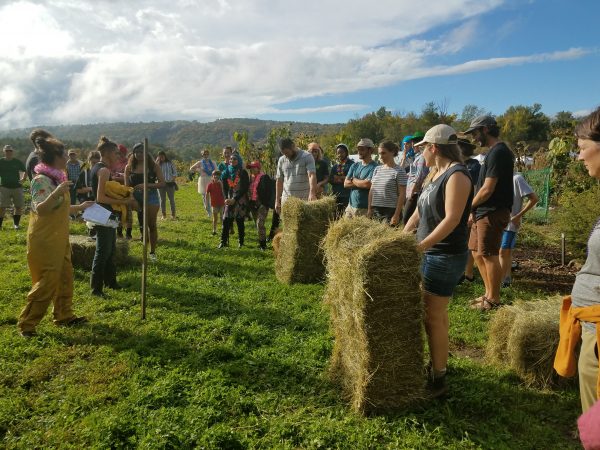
The Fall Festival at Just Roots in Greenfield
The Recorder, October 31, 2017, by Tinky Weisblatt
High on a hill on Reynolds Road in Shelburne, Wheel-View Farm enjoys a stunning view. The farm house and much of the land have been in Carolyn Wheeler’s family since 1896, although she and her husband John have added to their property over the years.
Originally a dairy farm, Wheel-View now sells mostly beef, fruit, maple products, and hard and sweet cider. When I visited a couple of weeks ago, the Wheelers were getting ready for Cider Days. I was fortunate enough to be able to watch John Wheeler press fresh cider and to taste his product.
The Wheelers have a small but efficient cider-pressing system they purchased from OESCO in Conway. John Wheeler explained that the press was discovered in Italy, where it is used to press grapes for wine.
The pressing has two stages. First, John feeds fresh, crisp apples into an electric grinder. When I visited he was using a blend of Golden Delicious, Macoun and Liberty varieties. Next, the ground apples are transferred to a round press with a “bladder” in the middle. The press is powered by water from a garden hose. The water fills and expands the bladder, pushing the apple pieces out to the edges of the press. Holes in the sides allow the cider to flow out in a waterfall.
When the cider has finished flowing, the dry leftover pulp becomes a treat for the Wheelers’ cattle. It is the only thing the cattle eat other than grass and hay from their own pasture. Nothing is wasted and the cider has a deep, rich flavor.
After the pressing, Carolyn Wheeler took me to her cider tasting room, which opened last year. Designed by Carolyn in an old outbuilding, the large, wood-paneled room welcomes visitors who want to buy cider or beef, as well as those who want to try a glass of hard or sweet cider on the spot along with a snack.
The tasting room is also a museum of sorts. Carolyn has filled it with antiques and collectibles from the farm’s past, including many pieces of household and farm equipment. As a music lover, I enjoyed testing her player piano and listening to “The Happy Wanderer” on her family’s Victrola. The bill of sale for the Victrola hangs on the wall behind the record player. “My family never threw anything out,” Carolyn said with a smile as she pointed to the receipt.
The Wheelers have welcomed a number of groups to the tasting room and the farm — from students to the members of senior centers and granges in the area. Their visitors are encouraged to try to identify the uses of the pieces of farm equipment on display.
The Wheelers are retired educators. They view Wheel-View not just as a source of food, but also as a source of information about farming practices in the past and present. As they look toward the future, Carolyn told me they hope the farm can be maintained as some kind of educational center.
Meanwhile, the pair are making the most of their life as farmers. They have recently revived a traditional New England apple product — cider syrup (also known as boiled cider), which John Wheeler’s grandmother used to enjoy. This is cider boiled down to concentrate the flavor. The pair sells it in three flavors: plain cider syrup, cider syrup mixed with maple, and cinnamon cider syrup.
Carolyn showed off the syrup’s versatility for me in a sweet and savory slow-cooker pot roast that also featured Wheel-View Farm’s beef. The recipe appears below.
Wheel-View Farm’s cider tasting room is open most weekends, although those interested are encouraged to call or check the farm’s website, wheelviewfarm.com, ahead of a visit. The tasting room will definitely be open for Cider Days this Saturday and Sunday, Nov. 4 and 5, from 10 to 4.
Wheel-View Farm cider syrup pot roast
Ingredients:
3 to 4 pounds beef roast
1 teaspoon garlic powder
1 teaspoon onion powder
1 tablespoon dry mustard
½ to 1 teaspoon salt
1 dash of nutmeg
Pepper to taste (¾ teaspoon to 2 teaspoons)
½-cup ketchup
2 teaspoons Worcestershire sauce
½-cup cider syrup or cider-maple syrup
Instructions:
Place the roast in a slow cooker. Combine the remaining ingredients and spread them on top of the beef. Cook for 6 to 8 hours on high. There is no need to add water; the roast makes its own gravy. You may also cook it on high for 30 minutes and then let the beef cook overnight on low.
If you don’t have a slow cooker, place the beef in a covered pan and spread the sauce on top. Then place it in an oven preheated to 500 degrees. After 20 minutes, reduce the heat to 250 and cook for several hours or overnight.
When the beef has finished cooking, remove it from the pot, cut it up if necessary (it mostly just falls apart, according to Carolyn Wheeler), and return it to the sauce.
Serves 6 to 8.
Food writer Tinky Weisblat of Hawley is the author of “The Pudding Hollow Cookbook,” “Pulling Taffy,” and the forthcoming “Love, Laughter, and Rhubarb.” For more information about Tinky visit her website, www.TinkyCooks.com.
The Recorder, October 30, 2017
Massachusetts was the first state in the nation to adopt Agricultural Preservation Restriction legislation, 40 years ago.
Since its inception, the APR program has permanently protected from development roughly 73,000 acres on 906 farms — with about 15,600 acres on more than 241 farms in Franklin County and another 12,860 acres in Hampshire County.
The program uses state money and private donations to buy the development rights to farmland so the acreage stays in production and isn’t paved over. This has allowed farmers, after decades of hard labor, to retire without liquidating their only asset, their land, and another generation can continue the calling.
“Nowhere else in Massachusetts could you look out on a vista like this and see so much protected farmland through the APR program as you can see from Mount Sugarloaf,” state Rep. Stephen Kulik noted recently as state and local officials gathered with farmers to mark the anniversary.
The program may have been questioned by urban legislators when it was first proposed, but it has proven its worth, said Senate President Stanley Rosenberg, whose district includes more APR farms and more protected acres than any other.
“We’re the stewards of this program, which came as a result of the hard work of legislators who preceded us,” said Rosenberg, citing former state Rep. and Agriculture Commissioner Jonathan Healy of Charlemont and former Congressman John Olver of Amherst, who was the original APR legislation sponsor when he was a state senator.
“You’ve not only preserved farms and kept them active and working, but you’ve helped people stay in the farming business, and to help pass farms on to children and grandchildren, and make it possible for new farmers who don’t have land to get access to land,” Rosenberg said, summing up the program’s benefits.
APR helps perpetuate farming as a way of life but also supports agriculture as an important piece of the Franklin County economy. It allows us to become locavores — eating locally produced meat, milk, cheese and yogurt, fruit and vegetables. Our beer and bread makers can also use locally sourced hops and grains.
Preservation also boosts agri-tourism, which is seen as a growing component of the regional economy. Our tourism generally depends on the pastoral countryside, which attracts summer wanderers, autumn leafpeepers and winter adventurers. When we think about the big attractions in Franklin County, it’s often our agriculture fairs, and events like Cider Days, Mike’s Maze in Sunderland or the North Quabbin Garlic and Arts Festival, all rooted in and celebrating local agribusiness.
And we get to live in the rural countryside, not suburbanized former farmland.
Richard Hubbard, former state APR director and current executive director of the Franklin Land Trust, said 90 percent of what you see from Mount Sugarloaf has been conserved.
“We’re not done yet here in the Valley,” he said. “It’s not a perfect program, but nobody’s figured out how to do it better,” despite similar programs in dozens of states.
Legislators 40 years ago realized that protecting prime agricultural land was a matter of public concern, and today we have them to thank for having the foresight to do something about it. Let’s hope that collectively, the people of Massachusetts, including our urban counterparts in the Boston area, continue to appreciate the benefits of APR and also continue to support it. Open land is a treasure for us all.
WRSI, October 30, 2017. Terry Ragasa of Sutter Meats in Northampton shares a bit of gabagool, recalls how CISA brought him to the Pioneer Valley, and talks about how you can learn to butcher meat yourself.
The Recorder, October 29, 2017, by Richie Davis
Whether it’s the upcoming Cider Days, Mike’s Maze in Sunderland or the North Quabbin Garlic and Arts Festival, there’s little doubt that agritourism is a key slice of bringing visitors to Franklin County — as well as a way to help area farmers beef up their bottom line.
Now, a bill filed by Rep. Stephen Kulik aims to create a state commission to find ways to “support, expand and enhance” opportunities for Massachusetts agricultural tourism — in part anticipating potential conflicts with local zoning, health boards and other regulatory authorities before they occur.
Kulik’s bill, House 2715, is scheduled for a public hearing Tuesday at 1 p.m. before the Legislature’s Joint Committee on Tourism, Arts and Cultural Development. Co-sponsored by Rep. Paul Mark, D-Peru, as well as Sen. Adam Hinds, D-Pittsfield, and 19 other legislators, the measure is seen as “important to the future of agriculture” in the state, according to the Massachusetts Farm Bureau Federation.
In an “action alert” this week to encourage supporting testimony, the Farm Bureau notes, “The increased popularity of agritourism has not come without challenges. Issues have arisen with neighbors, local zoning, health regulations,” in part because “many of the existing laws concerning farm activities did not consider agritourism, resulting in many gray areas. In some situations, this has created uncertainty and conflict around agritourism.”
Kulik, a Worthington Democrat, said he doesn’t know of such conflicts in his Franklin-Hampshire district, but he said he is aware of problems elsewhere for Massachusetts farmers who have wanted to host weddings, operate bed and breakfasts or, in one case, even sponsor an on-farm road race.
The proposed nine-member commission would consist of farmers involved in agritourism, municipal officials and representatives of state agricultural, tourism and health agencies along with representatives of the Massachusetts Municipal Association and the Massachusetts Farm Bureau Federation. It would also look at agritourism in other states and within 12 months report back on how state programs and policies here could help encourage this tourism sector.
“Agricultural tourism is critically important as we look at the future of tourism in Franklin County,” said Natalie Blais, the new executive director of the Franklin County Chamber of Commerce. “It would be enormously helpful if we could find ways for local farmers to diversity in that way.”
While there is no measure of agricultural tourism here, or around the state, Kulik said that would be an outcome of the proposed bill, along with an analysis of its potential for growth.
A 2008 conference on agricultural tourism in the state found more than a 100 percent increase in Franklin County farms with tourism-related activities over the preceding decade, including roadside stands, pick-your-own operations, restaurants, tours and other amenities. Neighboring Hampshire County saw a 300 percent increase, the highest in the state.
The state Department of Agricultural Resources publishes and distributes a free agritourism map listing more than 400 sites around the state, including nearly 50 attractions in Franklin County. The Massachusetts Office of Travel and Tourism, which Kulik said could be encouraged to do more promotion of agritourism, sponsors media tours, such as an upcoming visit by Italian travel writers that Blais plans to bring to Apex Orchards, Clarkdale Fruit Farm and Wheel-View Farm for Franklin County Cider Days next weekend.
Although Kulik said his bill does not seek any funding, the commission that it would create could call for an appropriation to encourage more agritourism.
On the Web:
malegislature.gov/Bills/190/H2715
http://bit.ly/AgtourMAP
You can reach Richie Davis at: rdavis@recorder.com
or 413-772-0261, ext. 269
Folklore and fiction are full of pumpkins hovering around the intersection of everyday people and the supernatural: Cinderella’s carriage turns into a pumpkin, the headless horseman of “The Legend of Sleepy Hollow” wears one where his head would be, and the Irish folk character Stingy Jack, who wanders the Earth with a pumpkin lantern after making a deal with the devil, is part of the origin of the Jack-O’-Lantern. It lives in the odd cultural space that flirts with elements of horror in a playful and unthreatening way, like Scooby Doo and kids’ Halloween costumes. And yet, unlike Dracula and Frankenstein’s monster, pumpkins also transition easily from the haunted house to the dinner table.
Make your own fresh pumpkin puree from local pumpkins by slicing them in half, scooping out the seeds, covering the flesh in oil, salt, and pepper, roasting at 400°F for 30-40 minutes, and scooping out the now-soft goodness. I recently got an immersion blender and have been experimenting with pumpkin soup, which can be as simple as simmering pumpkin, stock, and aromatics (like onion, garlic, and herbs) together and blending. A little heavy cream (or yogurt) helps make the soup nice and creamy.
Valley Bounty is written by Brian Snell of CISA (Community Involved in Sustaining Agriculture)
Stone Soup Farm is hiring for full and part time fall harvest work starting right away. We’re also looking to hire some one for part time work throughout the winter. Must have experience working on farms. Pay is competitive and based on experience. Email stonesoupfarm@gmail.com or call Dave at 603 731 6368. Thanks!
The Daily Hampshire Gazette, October 24, 2017, by Claire Morenon
For many of us, fall is the season for annual traditions that bring people out to the farm: apple and pumpkin picking, corn mazes, hay rides, and farm festivals.
It’s an easy pitch — spend a crisp fall day enjoying the season outdoors, with delicious farm-fresh food as your reward? Yes, please!
For much of our nation’s history, the vast majority of the population lived and worked on farms, but today, less than 2 percent of the population works in agriculture. In recent decades, we’ve seen a growing interest in reconnecting with the seasons and our shared agricultural heritage, as more people seek out local food and prioritize supporting local farmers. Spending leisure time on a farm strengthens that connection, too, and many more now offer on-farm activities.
Between the 2007 and the 2012 Agricultural Census, the number of farms engaged in “agritourism” grew from 154 to 287 statewide, and farm income from those activities grew from $5.3 million to over $12 million. The range of activities has increased. In addition to pick-your-own apples and pumpkins, farms are offering corn mazes, food festivals focused on crops from lavender to garlic, art installations, and theater events.
The Fall Festival at Just Roots in Greenfield
For local farmers, there are clear benefits to welcoming the public onto the farm: it’s a rapidly growing segment of our agricultural economy that can provide a much-needed income stream. Bringing hungry customers to the farm can benefit on-farm sales of other products significantly. And, of course, many local farmers enjoy having their farm function as a gathering space, providing the first exposure to farms for city visitors, and welcoming families over generations.
Still, as with any new enterprise, farmers have to carefully consider the costs and the risks. To accommodate guests, farms have to carry additional insurance, expand their facilities to allow for bathroom breaks and other needs, and hire additional staff to run the hay rides or cover ticket sales and concessions.
Land that’s used for agritourism activities, whether that’s a corn maze or just additional parking to allow for visitors, usually isn’t used for other crops. Corn mazes, for example, grow all summer long and the land compacts under all those visitors’ feet. And it’s often not worth the crew’s time to follow the public into picked over pick-your-own fields and orchards for additional harvest.
Farming is an inherently weather-dependent venture, and that is doubly true for agritourism – a series of cold or rainy weekends will seriously undermine the income realized by a pick-your-own operation, and one bad day can undercut a farm festival entirely.
And, of course, there are lifestyle considerations. Farmers are still working long hours pulling in fall harvests, and tossing a haunted hay ride into the mix isn’t manageable, or desirable, for all farms.
Happily, there are dozens of local farms that have weighed all these considerations and decided to welcome us onto their land. It’s important to remember that these are working farms, which means that there can be dangerous equipment in use, fields that appear empty but are actually freshly planted, livestock that can spook, electric fences, and sometimes pesticides or herbicides in use.
When visiting a farm, it’s important to respect their posted boundaries and ask permission before feeding or interacting with animals in order to stay safe. Remember that not all farms, even those with farm stands, are equipped to handle visitors throughout their whole farmland, so make sure you know the areas open to the public before exploring.
Now that you’re armed with all this behind-the-corn-maze knowledge, be sure to get out there and enjoy all that local farms have to offer this fall. Spend an afternoon picking pumpkins or wandering in a maze and create memories that will carry you through the winter.
Don’t already have a favorite spot to visit? Follow CISA on Facebook and Instagram for events and crop updates.
Claire Morenon is the communications manager at Community Involved in Sustaining Agriculture in South Deerfield.
WRSI, October 23, 2017. Kathleen Smedberg of Green Acres Fruit Farm in Wilbraham talks about showing customers why a trip out to the farm is well worth it and discovering that the reality of farming doesn’t look quite the way it does in children’s books.
When it comes to first-thing-in-the-morning caffeine intake, I have to admit that I am a staunch member of Team Coffee. For a number of reasons—some habitual and some simply chemical—I’m not especially interested in making significant changes to that particular morning routine. But as cold nights begin to settle in for the season, I do find myself wanting a warm cup of tea in the evening, but without the caffeine jump-start. Fortunately for me, there are a number of local farms offering herbal tea blends at farmers’ markets, farm stands, and local retailers.
Most herbal “teas” don’t actually contain any Camellia sinensis, the plant whose leaves are used to make green, black, and Oolong teas. They’re blends of other herbs that are steeped in water to make a tea-like drink. Herbal teas have been used in traditional medicine to treat ailments and promote the good health of bodily systems—there is a wealth of information online if you’re curious about which blends have been used for particular purposes, and farmers that specialize in herbs can help point you in the right direction if you visit them at the farmers’ market. I usually drink mine with a drop of lemon juice and a splash of honey.
Valley Bounty is written by Brian Snell of CISA (Community Involved in Sustaining Agriculture)
Daily Hampshire Gazette, October 20, 2017, by Lisa Spear
A bowl of curried sweet potato soup with cilantro, lime and coconut milk. A cheese pizza made from scratch. A beefy burrito with salsa. These are the sorts of meals that warm your belly and your soul. They are comfort foods that conjure up thoughts of lazy afternoons spent cooking. The trouble is, there seems to be a shortage of lazy afternoons.
Time is a luxury that many people just don’t have.
That’s where Betsy Hennemann, 46, and Molly Merrett, 36, come in. These two are each part personal chef and part delivery woman.
Hennemann is a one-woman band, an entrepreneur who runs the business Your Family Chef out of her Chesterfield home. Merrett runs Beets & Barley in Haydenville, with one part-time employee, which provides vegetarian and vegan meals. They are part of a niche market that caters to people throughout western Massachusetts who don’t have the time to cook for themselves, but still want to eat nutritious, farm-fresh food.
“I feel like I am giving my customers more time to do the things that they love,” Hennemann says. It means less time worrying about food and more time eating it, the women say.
Merrett alternates dishes seasonally. Hennemann’s menu changes each week.
They both offer reliably affordable meals that range in price from $7 to $10. They say that their services can cut down on waste and customers can even save money on their grocery bills. Neither of them have a culinary background. They just have a love of food and a passion for feeding people.
The Beets & Barley menu is listed online. Hennemann, who doesn’t yet have a website, creates a new Your Home Chef menu every week that she shoots out by email to her subscribers every Friday. Some of Hennemann’s dishes are old favorites like the enchiladas, others like salads with homemade dressing make an occasional appearance. Both deliver up to a week’s worth of food, depending on customers’ orders, one day a week.
The concept is similar to the slew of national meal delivery services like Blue Apron, that delivers ingredients and a recipe to customers’ doorsteps. Then there is Plated, which promises chef-designed recipes and precisely measured ingredients delivered each week. As these national meal delivery services have sprung up over the years, local entrepreneurs have taken notice and have opted to offer consumers something the big companies can’t: “It is very personal and that is the way I like it,” Hennemann says.
Hennemann and Merrett often see their clients at their front doors. They meet their families. They know their dietary restrictions, offering gluten-free, and vegetarian options. There is also no long-term commitment. Customers pay for meals as they go each week, unlike many of the national companies that require an ongoing subscription.
“There was nowhere for local, scratch-made food around here, so I thought, ‘alright let’s give it a shot,’” says Hennemann, who launched Your Home Chef almost two years ago. “Cooking has always been my art.”
Your Home Chef
On a recent Monday, a 2-foot tall caldron of beef chili is simmering on the stove in Hennemann’s work kitchen in a renovated part of her basement. She stirs, barely looking up from the pot, a baseball cap low on her forehead. She spends hours down here every week hovering over hot plates. Sometimes it gets lonely with just her creations like savory cheese pies and veggie lasagna to keep her company, she says.
But after a 22-year career as a preschool teacher, she needed a change, she says, and took a risk to launch her business. To get the word out at first, she told friends around town and advertised through social media. It caught on fast: She has a few dozen regular customers. About 200 people get her weekly menu and about 30 to 45 orders — which usually includes multiple meals each — come in every week. Some people buy a week’s worth of food, others just want lunch or dinner for that day. Right now, she says, she can handle making only 120 meals per week. This is all on top of regular catering jobs.
She hasn’t established geographic boundaries for her delivery service yet. So far, most of her customers are in the Hilltowns, but she has customers as far away as Greenfield. She spends a whole day each week driving around to make deliveries. “It is such a challenge, but I’m happy,” she says.
Her husband Wayne, 51, and her son Jack, 11, get what she’s cooking for her customers. “If my son wants something now he will ask me to put it on the menu because he knows that’s the only way he will get it. My husband started sending me his order by email so I don’t forget about him.”
Since Hennenmann is at capacity now, she plans to hire a few employees and open a small grab-and-go store front in Williamsburg within the next few months. Though she will still deliver and her services will not change, this will enable her to cut back on driving, so some of her customers can come to pick up their meals on the way to or from work.
One of her customers, Barbara Simpson of Easthampton, says she eagerly awaits Hennemann’s new menu each Friday morning.
“I tell people I have a personal chef,” she says.
The offerings are limited but creative and the ingredients come from local farms — like the beef from Fuller Farm in Chesterfield. Hennemann doesn’t use recipes, so nothing ever quite tastes the same.
On a recent week’s menu, she had listed just one breakfast item and two entrées:
The “breakfast scramble” came with organic eggs, house-made turkey sausage, potatoes, broccoli and cheddar scrambled together for $7 a serving.
Then there was the “Turkey Crust Pizza,”: which, as advertised, has ground turkey in the crust as well as mozzarella cheese and eggs. It is topped with marinara sauce, a bit more mozzarella, pepperoni, sweet peppers and broccoli. A single serving is $8, a double $16 and family sized costs $32.
The second entrée was BBQ ribs with mashed potato waffle cakes. The pork ribs came with house-made BBQ sauce. The potato cake batter is a mixture of mashed potato, eggs and flour. The waffle cakes are served with sour cream and chives. Farm fresh zucchini and summer squash came on the side.
“When I tell them it is also affordable, they are surprised,” Simpson says of her friends and acquaintances.
When they’re available, Simpson often goes for the low-carb choices like the salads, but the whole family, which includes her husband, Scott, 56, their son, Kyle, 27, and daughter, Sarah Luce, 25 — who is an emergency room nurse in Springfield, and likes to drop in on short notice — tend to like the Mexican dishes like enchiladas.
Since all of her family members have hectic schedules, it helps to have ready-made food on hand, she says. “Ideally it’s good to eat together, but when you are hungry, you eat when you can.”
As an insurance company manager in Westfield, Simpson has to travel a lot for business, she says, so she wanted to cut back on cooking. She first looked into getting a Blue Apron subscription, but didn’t want to make a long-term commitment. Around that time, she was sitting in a nail salon in Southampton, when she overheard a conversation about Your Family Chef. She found Hennemann’s price to her liking — Simpson spends just $48 for six meals every week — and became hooked right away.
“It’s delicious, healthy, convenient, reasonable — Why wouldn’t you do it?”
Beets & Barley
Like Hennemann, Merrett also buys her ingredients for Beets & Barley from local farms, like Atlas Farm in Deerfield and Stone Soup Farm in Hadley.
Her meals, too, are simple, comfort foods, like pad thai or baked macaroni and cheese with butternut squash and kale. All of her dishes are vegetarian, with many vegan offerings mixed in, like the black bean and sweet potato chili or the kale Caesar salad and roasted root vegetable. By cutting out meat, she says, she is able to keep her meals at about $10 per serving.
Merrett works in the industrial kitchen she rents in the back of a church in Haydenville.
She typically delivers about ten to 20 meals per week from her menu which has about eight entrees. All of the dishes are offered in either a 16 ounce or 32 ounce container for $10 and $18.
For dessert, customers can order cookies like double chocolate or ginger molasses.
Merrett divides her time between delivering meals, catering and selling her dishes at local farmers markets. She also wholesales food to local establishments like the Atlas Farm Store in South Deerfield.
She started Beets & Barley in 2013 after studying sustainable agriculture at Hampshire College and then spending several years as a farmer. During her time on the farm, she says, she encountered people who said they often wanted to eat healthy, plant-based diets and support local farmers, but just didn’t have the time. That, she says, inspired her to start Beets & Barley.
“I found that there was a disconnect between people having all these great veggies available and no time to prepare them,” she says.
She put up a few fliers and word spread fast, she says. “This is a way for people to access quick meals made with locally grown produce.”
To order or get on Your Family Chef’s weekly menu, email YOURFAMILYCHEF@YAHOO.COM
Beet & Barley offers free delivery to Northampton, Easthampton and Williamsburg. Delivery is available to other towns for an additional fee of $1.50 per mile from the town center of the nearest above mentioned town. Orders must be placed by 9 p.m. on Wednesday for delivery the following Monday
To order meals from Beets & Barley, visit http://www.beetsandbarley.com.
Recipes from Beets & Barley
Roasted Root Vegetables with Garlic and Sage
This recipe can be cut in half for a small gathering, or scaled up for a crowd. Other root vegetables, such as carrots, parsnips or turnips, can be added in as well, just make sure you have about 6 pounds of vegetables.
2 pounds yellow potatoes
2 pounds orange sweet potatoes
2 pounds red beets
6 medium sized garlic cloves
¼ cup olive oil
2 teaspoons dried sage, or 12 fresh sage leaves
2 teaspoons sea salt
½ teaspoon fresh ground black pepper
Preheat the oven to 400 degrees. Scrub or peel the vegetables and cut them into 1-inch cubes.
Combine the garlic, olive oil, salt, pepper and sage in a mortar and pestle or food processor. Toss the vegetables in the oil mixture.
Spread the vegetables in a single layer onto two large baking sheets lined with parchment paper. Bake for 40 minutes, rotating trays halfway through. Let cool for 10 minutes. Transfer to a serving dish.
Taste and add more salt if needed.
Serves six to eight people.
Massaged Kale Salads with Apples and Almonds
Beets & Barley typically uses one bunch of green kale and one bunch of dinosaur kale in this recipe, but any variety that is not too tough or mature can be used.
2 large bunches kale, about 1½ pounds
2 firm apples such as macoun or cortland
½ cup chopped almonds
2 tablespoons olive oil
1 lemon, juiced
1 tablespoon maple syrup
1 teaspoon sea salt
Wash the kale and shake dry, then remove the leaves from the stems, and tear leaves into bite-sized pieces. Heat a small skillet on the stovetop, and toast the almonds until they are fragrant and just starting to brown — set aside.
Cut the apple into ¼-inch cubes, and toss in a little lemon juice to prevent browning.
In a small bowl, whisk together the remaining lemon juice, oil, maple syrup and salt. Pour the dressing over the kale, and massage with your fingers until the kale has softened and darkened, 3 to 5 minutes.
Taste and add more salt if needed. Top the kale with the apple and toasted almonds.
Serves four to six people.
Recipe from Your Home Chef
Turkey Crust Pizza
For the crust:
1 pound ground turkey
1½ cup mozzarella cheese
2 eggs
1 teaspoon Italian seasoning
½ teaspoon salt
Mix all ingredients well. Spread into your preferred pizza pan, pressing with fingers until about ½- to ¾-inch thick.
Bake at 350 degrees until lightly browned (about 15 minutes).
Remove the crust from the pan and wipe the pan with paper towels to absorb the moisture to allow the crust to crisp up a bit.
To finish the pie:
Top with your favorite sauce, cheese and toppings, then pop back into the oven for 5 to 10 minutes, or until cheese melts.
Slice and enjoy.
Hampden/Hampshire Conservation District is seeking a part-time District Administrator. The program administrator will carry out all duties and responsibilities related to district programming, fundraising, day-to-day office duties, and secretarial duties related to supervisor meetings. Responsible for the general upkeep of the district office, record keeping and book keeping. Plan and coordinate district plant sales, meetings, and events. Prepare agendas and reports and take minutes at meetings. Write, update, and oversee grants. Must be proficient with Microsoft Office, social media websites, and have basic financial skills. Digital design experience helpful. The applicant must be able to work effectively with very little oversight and pass a background check to gain access to the USDA computer network. Time requirements are generally 8 – 10 hours a month but considerably higher for district plant sale.
Please contact John Omasta at hickorydell@aol.com if you are interested. Resume appreciated.
The Recorder, October 19, 2017, by Richie Davis
SUNDERLAND — Customers know The Blue Heron restaurant for its fine dining specializing in using locally sourced ingredients for an upscale menu that’s varied, if not necessarily New England, cuisine.
But for a special 20th anniversary celebration planned for Oct. 27, owners Deborah Snow and Barbara White will feature a special Gullah menu that harkens back to their travels to the sea islands of South Carolina.
The “evening of Gullah culture and living” will feature stations serving specialties of the “low country” like She-Crab Soup, Pan-Seared Redfish with Succotash, Fried Green Tomatoes, Sautéed Okra and Fried Chicken with Country Ham Gravy.
Inspired by their lifelong love of food and hospitality, Snow and White opened the Blue Heron Restaurant on the banks of the Sawmill River in Montague in 1997. The Blue Heron quickly rose to prominence as one of the best restaurants in the Pioneer Valley. After a successful six-year run, Snow and White went in search of a new location to accommodate their growing customer base. The vacant Old Town Hall in Sunderland seemed like the perfect spot, and in 2004 the Blue Heron re-opened in its current home.
The Blue Heron is an intimate, relaxed upscale restaurant featuring globally inspired cuisine sourced ethically from the valley and beyond.
In addition to the Gullah-themed special menu, the “American Gullah Collection” celebration will feature the singing of contralto Xan Jennings, an Orangeburg, S.C., native with a master’s degree in music from Indiana University along with artwork by South Carolina artist Sonja Griffin Evans.
White and Snow met Evans in March when they revisited the South Carolina islands they explored 23 years ago as they contemplated opening a restaurant together.
“Barbara and I traveled, spending four months in an RV and visiting the Beaufort, S.C., area,” recalls Snow of the days after she left her job as head of dining services at Northfield Mount Hermon School, where White had been dean of residential life. As they contemplated where they would open their restaurant together, the two women visited The Red Piano Gallery, the oldest professional fine art gallery on Hilton Head Island, S.C. They explored Saint Helena Island, home of one of the first schools for freed slaves and one of the sea islands where enslaved Africans, mostly from Sierra Leone’s rice-growing region, were brought to work on rice plantations.
The Gullah culture, with its unique crafts of sweetgrass basket weaving, unique dialect and folklore, developed there in relative isolation on the islands from the mix of these slaves, as well as native tribes and indentured servants from Europe.
“We just loved the area,” Snow added. “It just really spoke to us about the strength and courage of the people and maintaining their local traditions. The African traditions there are probably much stronger there than anywhere in the U.S.,” in part because there were no bridges connecting the islands to the mainland until the mid-20th century, she said.
Meeting Evans and re-experiencing the Low Country culture this spring touched off conversations about a program to share the culture with this region, with its own strong history of the Underground Railroad, Sojourner Truth in Northampton and John Brown in Springfield.
The dinner, for which reservations are necessary, is one in a series of cultural events hosted by The Blue Heron over the years. Last year, it presented “a dinner and a conversation about race in America,” featuring authors Julius Lester and Barry Moser, black and white former Southerners sharing their very different experiences around race growing up in that region — and today.
Snow, a native Midwesterner who has been executive chef of the restaurant, said the Southern tradition around food is built around a strong connection to farms, although that connection in the South — where the growing season is longer and there’s probably more access to food anyone can catch or grow — has always been a strong one.
Closer to home, White and Snow watched as the local food movement has taken root over the past 20 years, with the emergence of Community Involved in Sustaining Agriculture’s “Local Hero” campaign playing a major role.
“When we began, there was no local food movement,” said Snow, who recalls their conversations with neighbors Deb Habib and Ricky Baruc about their plans to start Seeds of Solidarity Farm and their own plans to launch their restaurant. They began buying salad greens from the Orange farm from the start, as well as Diemand Farm, Mapleline Dairy, gradually working with other local growers as they geared up.
“The farms have grown, and there are so many of them,” she said, recalling that at the outset few of them delivered, so the co-owners would have to collect corn from Warner Farm and other farms. “The availability has really grown, and there’s so much variety that we have to make choices now.”
The restaurant, which started out at The Montague Mill, with a very small kitchen and seating for 40 to 60, launched “kind of at the number five,” Snow recalls: five red wines, five white wines, five appetizers, five entrees. In Sunderland, where there is room for as many as 200 and a full-time staff of 15, the menu has grown, often around what’s in season locally.
“We’ve really listened to our customers, who sometimes have told us this dish is too big,” said White, who retired about five years ago as the restaurant’s general manager. So it began offering smaller versions of full-size items. From the beginning, it has also served hamburgers, made from cattle raised at Shelburne’s Foxbard Farm, and welcomed customers who just want a burger or a salad, or just drinks and a snack.
“Our image has always been this high-end restaurant, and people felt, ‘I can’t go there …’” she said. “We haven’t changed our white-tablecloth look, but we present ourselves in a way that’s much more open and tell people, ‘It’s OK.’”
Snow adds that The Blue Heron, which does about 20 percent of its business catering private occasions, business retreats, parties and campus events, sometimes gets asked, “What’s your food like?”
“I tell people, “It’s kind of what we like to eat. And when we get bored, we change the menu.”