VB: Abundance Farm
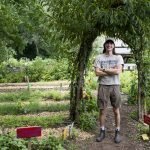 Abundance Farm grows a sense of community alongside food. Nat Ross is the farm manager and says, “We serve a wide-ranging and diverse community, and there’s absolutely no restriction on who can come to the farm to harvest or attend events. Anybody is welcome here as long as they’re respectful of other people and of the land itself.”
They continue, “This comes from a belief in inclusivity and a belief in the universality of what we’re doing; the idea is that anyone can come and harvest anything that’s available. We provide food that’s grown without pesticides or herbicides: it’s food that’s grown with care and community.”
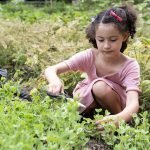 Ross says, “The simple act of harvesting your own food and having a relationship with the land in this communal atmosphere is really powerful. We think it provides not just material nourishment, but spiritual nourishment and community connection in a holistic way.”
The farm’s roots are in community, social justice and faith. Abundance Farm land was once Northampton’s historic ‘poor farm.’ In 2011, Emmett Leader, a local community member, started a garden on a patch of underused land at Congregation B’nai Israel (CBI) in Northampton. With his family and community, they established a farm on Prospect Street, growing food for themselves and donating to the Survival Center next door.
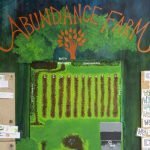 A few years later, Rabbi Jacob Fine formalized the vision into Abundance Farm. Working with the congregation and community, they transformed the CBI garden into a small farm and outdoor classroom in partnership with its neighbors at Lander-Grinspoon Academy and the Northampton Survival Center. Ross says, “We’re grateful to have a supportive structure with CBI, who provides administrative and communications support to the farm.”
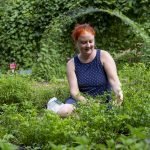 “Community” at Abundance Farm includes people of all faith affiliations (or none at all), community members at CBI, neighbors and children who participate in other programs at the CBI campus. The farm feeds this community by drawing upon the Jewish agricultural tradition of “peah,” Jewish law, written in the Torah over 2000 years ago, which sets a foundation for care of the land.
Ross notes, “The law says that you should leave the edges of your fields unharvested if you’re a farmer, so that others who are in need can come harvest for themselves. That is the basic underpinning of everything we do…we just say, ‘oh, we’re all edges, actually.’”
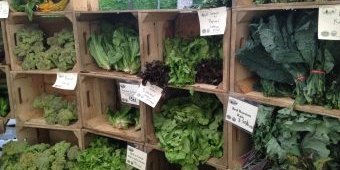
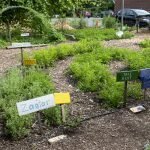 There are over 70 crops on just one acre of land. Free, pick-your-own food is available to all who visit. They say, “Anyone can come. It’s about dignity and it’s about taking off the burden of means testing for people. We just ask that people take into account their personal situation when they come harvest.” The farm is marked with signage indicating what is ready, what is limited and which crops are abundant.
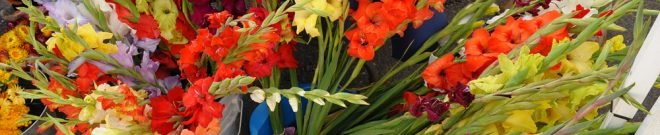
The offerings include vegetables, fruits, herbs and flowers. Available right now: cucumbers, peppers, cherry tomatoes, arugula, baby kale, flowers, herbs and blackberries. Apples and pears are on the horizon.
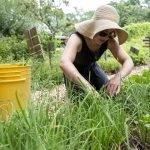 The farm relies on volunteers to plant and tend the crops. In addition to volunteers who show up for a big spring work day in May, up to 25 teen interns spend six weeks each summer learning about food justice, climate justice, farming and community building through the Shefa (Abundance) Teen Program on the farm.
Ross says, “They’re certainly doing a ton of great work here. Education is a big part of what we do.” Community, Justice and Education are the pillars of the program, and farming is the perfect landscape for all three. Former Education Director, Nili Simhai, built the educational program from scratch, and now Farm Educator, Avi Abraham, stewards the thriving program.
Care is the mission of the farm, and environmental stewardship is visible. Ross says, “We’re absolutely an environmental program. Part of our mission is taking care of the ecosystem and spreading the word about how to do that, along with a message of hope.” They continue, “There’s a lot of hopelessness, especially among young people, and I’ve personally seen how, when you farm ecologically, you can make a huge change in your local community and in your local ecosystem.”
They say, “Climate change impacts us: we deal with long periods of drought and now we’re dealing with really heavy, dumping rains.” Ross explained that they actively manage the impacts of climate change on Abundance Farm by minimizing their tillage to build soil health, which increases the capacity of the soil to hold water.
The farm brings Ross joy. “For me, one of the biggest things is seeing the kids who are here on the farm every day. The farm is a place where kids develop a sense of stewardship. One young child will say to another five-year-old, ‘Hey, you’re stepping in the wrong place. You need to step on the wood chips, so you don’t hurt the plants,’” they say.
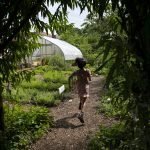 Ross concludes, “It brings me so much joy to know that we’re not just telling the kids what to do. They’re internalizing this and they know you have to take care of the land, which is really awesome.”
Abundance Farm is at 237 Prospect Street in Northampton. A relaxed, Community Harvest orientation helps visitors understand the farm and how to harvest and also offers an opportunity to volunteer. All abilities are welcome for planting, orchard care, weeding and mulching. Staff and volunteers are available to answer your questions on Wednesdays from 3:00 to 6:00 p.m., until October. For more information about family and community events, see www.abundancefarm.org and their social media.
Lisa Goodrich is a Communications Coordinator for Community Involved in Sustaining Agriculture (CISA). To find local farms and options for Fun on the Farm, see buylocalfood.org.
This article was published in the Daily Hampshire Gazette on 8/15/26. All photos by Daniel Jacobi III, courtesy of the paper.