VB: Bashista Orchards
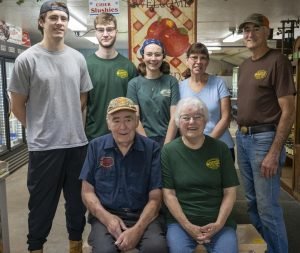
Jacob Bashista, back left, Johnathan Bashista, and Amanda Bashista, the three children of Cheryl and Thomas Bashista, with Thomas’s parents front left, Thomas and Jean Bashista. CAROL LOLLIS
“Our little part of Whiteloaf Mountain probably hasn’t changed much, other than I’ve added more trees and we got rid of the cows,” says Tom Bashista, fourth generation farmer and steward of Bashista Orchards in Southampton.
Bashista’s great-grandfather, Jacob Bashista, came from Poland in 1909 with his wife, Sabina, and his brother, Frank. The family purchased the farm in 1920 in Southampton and operated it as a dairy, selling to H.P. Hood. The family planted apple trees too, and in 1926, Bashista Orchards grew to nearly 100 acres. This year the family celebrates the centennial of their family farm.
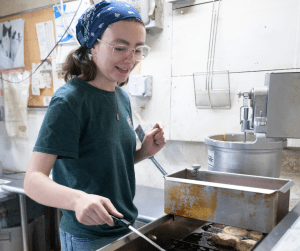 Today, Tom and his wife, Cheryl are the co-owners of the orchard. While Tom can be found on a ladder in the orchard, Cheryl handles all the paperwork and assists in the store during September and October. Their son, Jacob, helps with the cider making and harvest. Their other son, Jonathan, helps with marketing and website building, while their daughter, Amanda, is involved with event planning, retail sales and works in the bakery alongside a family friend.
Bashista continues, “There really isn’t a whole lot of difference between the way our property is now and the way it was back then, other than the road was dirt in 1920 until the 1940s.” He says, “Otherwise, the woods that were woods when my great-grandfather bought this property are still woods and the fields that were cow pastures way back then are still fields.”
 While the farm was still primarily a dairy, Jacob planted the earliest apple trees on the property. Bashista retells some family folklore, “The story goes, that he came here with apple seeds in his drawers and he planted them when he got here.” He continues, “There are definitely some trees here that are 100 years old, including some really old Baldwins, McIntoshes, Cortlands and Yellow Delicious too. Jacob probably started with six different varieties, and now I’m up to over 60 varieties.”
The older apple trees are standard trees, which have been pruned, so that some are two feet in diameter, but twelve feet tall. Without pruning, the older trees would reach forty feet tall. Bashista recalls being up on 20-foot ladders or taller as a boy, and men being on even taller ladders, up to 40 feet.
He says, “the biggest difference in the orchard from then to now is the tree and row spacing. My grandfather had standard trees and introduced semi-dwarf trees to the orchard. He planted the trees 40 feet apart, where now the standard spacing is closer to 12-to-14-feet, just wide enough to pass through with a tractor.” Bashista continues, “I have a 20-foot row spacing, which is still twice the density of his. My tree spacing is tighter. When the tree branches as they mature, they’re just touching.”
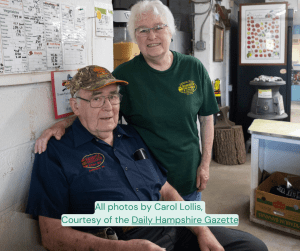 Each generation of Bashista added varieties and other fruits to the orchard. Tom’s grandfather, Walter, added pears and plums to the orchard. When he retired in 1981, Bashista’s parents, Tom and Jean, took over and owned the farm from the 1980s through 2009. The couple added peaches, nectarines, cherries, apricots and more apple varieties to the orchard.
Today, the farm sells both sweet and sour cherries, peaches, plums, apples, and pears. Tom Bashista added pluots—a plum-apricot hybrid—and another 20 varieties of apples. This year’s frost cut the cherry crop short, but plums and early peaches are coming up next, in mid-to-late July depending on weather. The earliest apples appear in mid-July. There are over 2,000 trees on 30 acres of orchard, with 60 varieties of apples for eating, baking and cider making.
When Tom and Jean took over the business and stepped away from dairy, the family focused on the retail store and added the bakery. In 1996, they added a cider mill in a space that was the milking room.
Bashista grows heritage varieties of apples for both sweet and hard cider. 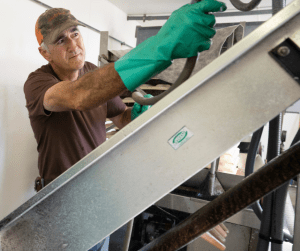 Bashista notes, “I’ve got a lot of old varieties of apples that we use specifically for cider making. We like to do cider for hard cider makers too, for people who like to ferment. When I do special blends for fermenters, it’s not the same cider as we sell in the stand, because in the stand, I like to have a consistent tartness and sweetness.”
With the apple varieties phasing in and out of ripeness, Bashista’s recipe for sweet cider and what he makes for fermentation require his careful balancing of sweet and tart flavors. He continues, “I always use a combination of apples to accomplish the same flavors through the whole season, which is difficult when your apples [varieties] don’t last the whole season.”
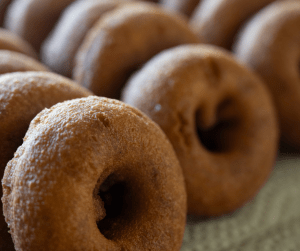
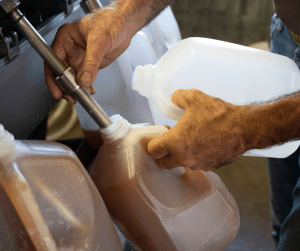 Cider is also the perfect celebration beverage, and Bashista Orchards always has sweet cider in their farm store when they are open (they take some time off in spring). Their cider and cider donuts have a loyal following in the community.
As the family celebrates 100 years in Southampton, the farm will host events to welcome the public to their orchard. On July 25, they are holding a craft-vendor fair with over 40 vendors, including food trucks. Music will accompany the day. In September, the family will host an official celebration, marking 100 years.
With Bashista’s roots in the orchard, Tom Bashista still finds joy in their family farm. He says, “I work hard because I like it. I watch the trees grow, and they are like full-size bonsai. I like knowing that what I do has an impact that I can see.”
Bashista Orchards Farm Store is open Tuesday through Sunday, 8 a.m. to 6 p.m. at 160 East St, Southampton. Details for events and the status of PYO are posted to the farm’s Facebook page, including the Craft and Vendor Fair on Saturday, July 25 from 10 a.m. to 4 p.m. PYO apples and peaches are expected for September.
Bashista Orchards Farm Store is open Tuesday through Sunday, 8 a.m. to 6 p.m. at 160 East St, Southampton.
Lisa Goodrich is a Communications Coordinator for Community Involved in Sustaining Agriculture (CISA). To find PYO apples, apple cider, cider donuts, and all things apple near you, see buylocalfood.org.
This article ran in the Daily Hampshire Gazette. All photos by Carol Lollis, courtesy of the paper.