VB: Letendre Farm
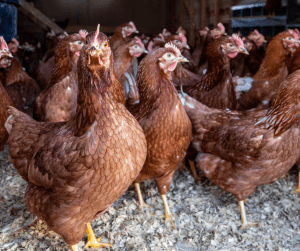 Spring is here and backyard chickens all around the Valley are responding to the longer days by laying more eggs – but at Letendre Farm in Ware, egg production is a steady, year-round affair.
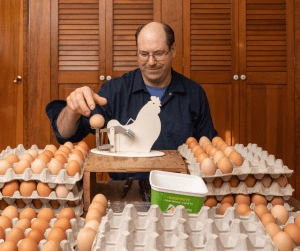
Letendre Farm was established by Mike Jacques’ great-grandparents, and today Jacques runs the business alongside his parents, Ralph and Jeanette Jacques. After two generations as a dairy farm, the family left the milk business in the late 1970s, and the younger members of the Jacques family carried on farming. Today they grow about 50 acres of hay and raise chickens for eggs. “My grandparents had a couple chickens, but nothing like we have today,” says Jacques. “My parents and I really expanded that around 15-20 years ago. We built a modern chicken house, and today we have about 600 layers who produce 30-40 dozen eggs a day. It’s all hand-picked, hand-washed, hand-boxed – no automation with that.”
Most of Letendre Farm’s eggs are sold at their farm store on Route 9 in Ware. There are a handful of customers who buy eggs to sell at their own small stands or farmers’ market booths, but most customers just buy a dozen or two at a time for their own kitchens. “We have our regulars from around town, from the Brookfields, from Palmer,” says Jacques. “And there are the people who travel. There’s a gentleman who comes to the Quabbin from Lexington and he always stops and gets 10-12 dozen eggs at a time, and another who comes out once a month from Leominster.”
The egg business has been through a lot of ups and downs in recent years. First, COVID-19 spiked demand for local products as people avoided bigger grocery stores or ran into supply shortages.
More recently, customers have seen surging egg prices and egg shortages at stores throughout the country. “We were able to keep our prices steady,” says Jacques. “When you can do it yourself and sell directly to customers, you can keep the price manageable. We thrive because we keep the pricing fair.”
Still, rising input costs do affect everyone. “Fertilizer prices spiked a bit this year, but I don’t buy a lot of that, just enough to keep they hay fields healthy,” says Jacques. “I use the chicken manure as an asset to keep the fields going too. I’m due to get a grain delivery in a couple of days and I’ll see how it goes, but it ebbs and it flows, and the prices do go back down. We just do our best, just do what we have to do.” Jacques also manages costs by producing his own bedding for the chickens, which he also sells to a handful of customers.
 That steady approach applies to the methods Jacques uses to raise chickens. “The way we do it, the chickens are in a controlled environment,” says Jacques. “We have lights on a timer so they keep laying eggs steadily throughout the winter. It’s not the cold that slows them down: it’s the lack of light. At night, we keep low-wattage red lights on. The red light soothes them and they can see what’s going on, so if something spooks them, like an animal outside or a storm coming through, it keeps them from running towards a corner and piling up on each other, which can kill them. In the summer, we open windows and run big fans to keep the air moving, and we keep it dark and cool to keep them calm and keep them from picking on each other. I wouldn’t say raising chickens is hard, but there are a lot of things to know and tips and tricks to keep the chickens safe and productive.”
The chicken house is also a hedge against future risks to poultry, specifically the looming threat of bird flu. Wild migratory birds are the primary carriers of the virus, and chickens can contract it from soil or water that has been contaminated by their droppings. “The bird house keeps us safer from the bird flu,” says Jacques. “We make sure customers come get eggs from our stand and don’t go into the chicken house, because they can track the virus in on their shoes.”
Jacques is happy to share his expertise – and the appropriate cautions – with anyone who is interested in raising chickens themselves. “Ever since COVID, and now the egg crisis, there are more people with backyard flocks, maybe five or ten chickens,” he says. “Customers will ask me for advice, and I’ll always give it. But backyard chickens have their own challenges, especially predators, and it’s not uncommon for us to see those customers back a few months later.”
Four generations in, Letendre Farm is in a settled spot. Jacques retired from his full-time job as a mechanic six years ago, and now can devote his time to farming full-time. His two daughters are in college, and the family is letting them find their own way. “I’d love to have them take over the farm, but it’s up to them,” says Jacques. In the meantime, he’s just enjoying the work. “You’re taking care of living things – it’s not just a job,” he says. “When you’re farming, you have good days, you have bad days, and you have really bad days. But when everything cooperates with the weather and everything else, you feel very fortunate. It’s a hard life, but it’s a rewarding life too.”
Visit Letendre Farm at 350 Belchertown Road in Ware. Official hours are 8am-1pm, but call 413-967-6875 for additional availability.
Claire Morenon, Communications Manager at CISA (Community Involved in Sustaining Agriculture). To find local farms and local eggs, visit buylocalfood.org.