VB: Golonka Farm
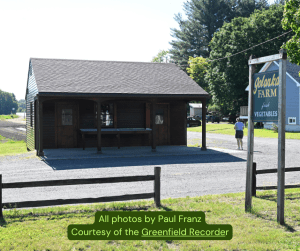 Golonka Farm is a beloved institution in Whately, famous locally for growing a wide variety of vegetables, for their fresh-picked sweet corn, and for the friendly, familiar faces that greet customers at their farm stand. The mission at Golonka Farm is straightforward: “We want people to come to our farmstand and feel welcome and safe,” says co-owner Jan Golonka. Her husband and business partner Jim Golonka adds, “We want to offer a good quality product at an affordable price.”
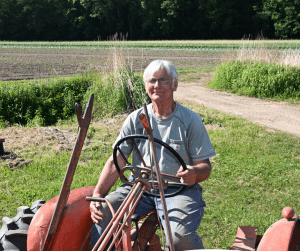 Jim’s farming story starts in 1956, when he was one month old. That year his parents, Mary and Bernie Golonka, bought the farm on Routes 5 &10 in Whately, just north of the Hatfield line. “They weren’t from farming families,” says Jim. “My father learned how to farm from magazines and textbooks and a couple neighbors who helped out.”
In the early years the family grew tobacco and cucumbers to sell wholesale, with the cucumbers mostly going up the road to the pickle factory owned by Oxford Foods in South Deerfield. Back then, Bernie worked at Greenfield Tap and Die, and Mary raised the eight Golonka kids. She was a formidable household manager who ran the family finances tightly enough that they paid off the farm within six years. That was a memorable landmark for young Jim: “When they paid off the mortgage, that’s when we got to have soda. We hadn’t had it before!”
When Jim grew up and got involved with the farm, initially he stuck with the model his father established. Then, even as he kept growing cucumbers for Oxford Foods, he added sweet corn and started to diversify his crops, selling a wider variety of vegetables from a little table on Routes 5 &10.
In 1984, Jim was on a trip to Vermont when he spotted Jan at a pub. “He came over and asked me to dance,” says Jan, “and then I moved down to Whately within —what— a year and a half?” They raised their kids, Emma and Steven, on the farm, and Emma remains very involved from Colorado, where she now lives. Steven took a different path and works as an electrical engineer in Boston.
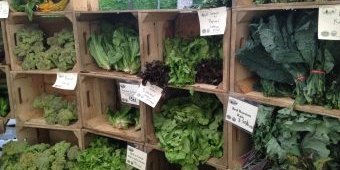
By the early ‘90s, demand for fresh vegetables had outstripped the capacity of their makeshift roadside stand. The family decided to build a permanent farm stand, which marked the shift into growing primarily for retail sales. Each year, when they open for business in mid-June, this stand is bursting with a wide selection of vegetables.
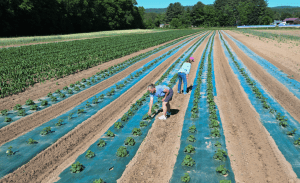 “We put a lot of effort into growing a variety so people can get anything they need for the week,” says Emma. “We grow close to 50 different crops and well over 200 different varieties—all the standard things, plus unusual herbs and less-common vegetables, like okra and fresh fennel. They’re not big money-makers but they’re fun to have and people appreciate them.”
The stand is also the locus of their connection to the larger community. “When we’re training new people to work at the farmstand we always say, ‘this isn’t just a job selling vegetables,’” says Jan. “We say, ‘you’re building part of the community—people want to know who you are, they want to know us, and to know who grows their food.’”
Building these relationships has taken the form of countless small interactions over more than three decades. Jim likes to experiment with new crops (“there’s so much to try!” he says), so when customers ask for a specific vegetable, he’ll grow them. “We had people asking for kohlrabi and so we tried growing a few, and now they’re really popular,” says Jan. “We had someone working at the farm stand that first summer who would encourage people to try them by saying ‘it’s a dollar’s worth of adventure!’”
“It’s always been very important to us to do a lot of custom orders, and to make sure people can get what they want,” says Emma. “People will call and say they need 15 jalapeños, and we’ll set them aside. Or someone will come in and say they’re looking for green tomatoes, and we’ll go out and pick them. Little things like that make a difference – in a world where access to a farm is increasingly rare, it’s special to know that you can talk directly to a farmer and they will provide what you need.”
Conversations with customers also give the Golonkas the opportunity to share information about their growing practices. “People will come in and ask if we’re organic, and Jim will explain IPM (Integrated Pest Management) to them,” says Jan. “They’re often very open to hearing about that.” Jim adds, “I’m really into building up the soil. We buy compost, plant cover crops, so our soil is pretty healthy. That’s very important.”
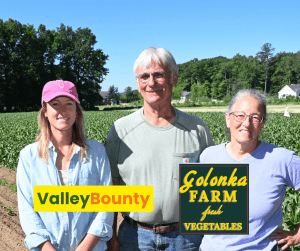 These days, Jim and Jan, along with Emma, are putting a lot of work into planning for the farm’s future. “We’re starting to think about what retirement will look like for us,” says Jan. “Our top priorities are to make plans that can keep the farm going, and to keep the farm stand thriving so it keeps providing quality produce at reasonable prices. Our main thing is that when we do make a change, we don’t want our customers to even notice.”
In April, Golonka Farm was recognized with a Local Hero Award, an annual commendation awarded by CISA (Community Involved in Sustaining Agriculture) for notable accomplishments in support of our local food system. The Golonkas received the award “for decades of hard work, for reliably serving as a source of great fresh food and community connection, and for careful planning for the future of the farm.”
These days, the Golonkas are preparing to open the farm stand in mid-June. “Every year when we open, people say, ‘oh my gosh, summer is really here!’” says Jan. For an exact opening date to experience their award-winning vegetables and customer service in person, find Golonka Farm on social media or at golonkafarm.com.
Claire Morenon is the Communications Manager at CISA (Community Involved in Sustaining Agriculture). To find local farm stands and fresh vegetables near you, visit buylocalfood.org.
All photos by Paul Franz, courtesy of the Greenfield Recorder.