VB: LaSalle Florists

John LaSalle of LaSalle Florists in his Whately greenhouse by Paul Franz, Greenfield Recorder
Like the flower varieties they grow, LaSalle Florists are a testimony to family heritage. John LaSalle is the owner-operator of LaSalle Florists and is the third generation LaSalle operating the floral business. When LaSalle’s grandfather, James LaSalle, sold his ice cream business to H.P. Hood and Sons in 1927, he started growing flowers as a hobby. Like the flowers themselves, his avocation grew, and in 1934, James and Bertha LaSalle bought a 16-acre parcel of land in Whately that had two barns on it. They built a glass greenhouse and a design room that remains the retail store for the thriving 91-year-old business.
“My grandfather had a hobby of growing gladiolas and dahlias. He built the greenhouse so he could see the results of his crosses of gladiolas,” explains LaSalle. “Crosses refer to cross-pollination of gladiolas. If you start them in a greenhouse, you can see them flower in one year, instead of two.”
John LaSalle’s father, Jim LaSalle Jr., officially joined the business in 1948 and spent his entire career working on site. He and his wife, Ann, expanded the retail side of the business. They added several greenhouses in the 1950s. Jim’s youngest son, John LaSalle, worked with his father for many years before taking over the business in 1979.
Until 1948, the business was primarily growing gladiolas for the wholesale market. LaSalle says, “When my father joined the business, they grew carnations, snapdragons, freesia, geraniums, and annuals.” He continues, “In the 1940s, Massachusetts was the largest carnation-growing state in the nation until California and Colorado discovered they could grow them better and for lower cost. As crops like carnations became less profitable, we started growing daisy chrysanthemums in the 1960s.”
LaSalle explains that “chrysanthemums, or mums, used to flower in the fall only. Back then, the primary variety was called ‘football mums,’ because people used to wear them to football games. In the 1960s and 1970s, we grew mums on year-round program. By manipulating the light, we could get them to flower all year-long. We got rooted cuttings and planted every two weeks to supply our shop.”

Alison George, a Senior at Franklin County Technical School in the Coop Program, works with cut flowers at LaSalle Florists in Whately by Paul Franz, Greenfield Recorder
Chrysanthemums flower when they get less than ten hours of daylight, so in the summer they used shade cloth on the crop to time flowering. In the 1980s, it was no longer profitable to grow chrysanthemums because they were being shipped in from South America and selling quality flowers for cheaper than local farmers could grow them. The farm stopped selling gladiolas when New Jersey growers started shipping into the area, and demand dropped.
LaSalle says, “We had been growing freesia on a small scale for our own use. The plant is native to South Africa, and back then, we could only get corms in September to flower in February. Then someone smarter than us figured out how to manipulate the dormant period of freesia. That meant that you could have bulbs to plant in September through December to flower from January through April.”
He continues, “That’s when we started growing a lot of freesia. We’re one of the few places around that actually grow freesia, and it’s definitely one of our biggest crops. People seek us out for them and will start calling soon to ask when we’ll have them.” LaSalle Florists are one of the primary growers of freesia regionally. In recent years, freesia flowers are being trucked from Canada, once again giving this local grower competition from afar.
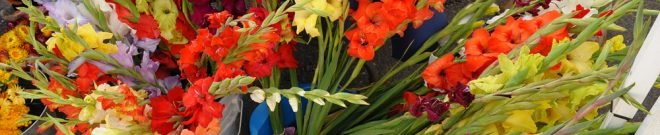
The family business grows the majority of their featured crops in their greenhouses and on their land. They have three acres of dahlias in their five-acre field. To supply the Boston and New York City flower wholesale markets, LaSalle staggers the planting of dahlias by color, leading with lighter spring yellows and pinks, and finishing planting with the desirable reds and oranges for autumn. In the course of a typical season, LaSalle will harvest 150,000 to 180,000 stems of dahlias.
LaSalle notes, “This year, everything was late due to heavy rain in May and June, when we couldn’t get into the field. It delayed planting by three-to-four weeks.” The dahlia crop depends on weather, both for planting in the spring, and for how long harvest continues in the fall. “We have an imminent possibility of frost. I can irrigate part of the field to protect the dahlias. The plants will bounce back if it’s a light frost, but a heavy frost ends the season,” says LaSalle.
Other crops LaSalle grows include traditional, white calla lilies. The florist also grows stock in spring and has a raised bed for classic summer blooms, like zinnias, celosia, snapdragons and lisianthus. As summer wanes this year, LaSalle planted heirloom chrysanthemums that are poised to be the showstoppers of 2025 for the business.
Heirloom varieties are generally older, non-patented varieties of a plant, in this case chrysanthemums. These older varieties are very unique, and so several years ago, LaSalle started taking cuttings for fifteen or so varieties from another grower. He says, “We grew chrysanthemums 20 years ago, so I had a lot of knowledge. We grew these varieties as cut flowers for ourselves and saved them as mother plants.”
In 2024, the Smith College Botanic Garden put on their final Fall Mum Show to make space for other exhibits, and they did not have a plan for the plants. LaSalle says, “I learned they needed to find a home for them, and I was entrusted with 50 or so varieties of chrysanthemums.”
LaSalle explains, “We didn’t know what a lot of them were, and so we grew them in the greenhouse to allow us to identify the varieties. We probably took 15,000 cuttings to get started. Many are older varieties, and most of them flower in October and November.” This will be LaSalle’s first year selling these heirloom chrysanthemums to the public, and he is hopeful that these special varieties will draw keen interest from the larger community. LaSalle notes there are few chrysanthemums grown locally anymore.
After all these years, community still brings joy to LaSalle. He says, “When people come looking for particular flowers and call for favorites, we are connected to the larger Valley community. People like that our flowers are fresher, because we grow them ourselves. Even when I drop off in Boston and New York, it’s fun to see people eagerly looking into my van, waiting to see what I brought.”

John LaSalle by Paul Franz, Greenfield Recorder
“I miss working with my dad, though. He managed the business end while I handled growing plants. Now I go to cut flower grower meetings, and I’m one of the old guys. I hope to retire one of these days. I like to pass along my knowledge and help people in the fields,” says LaSalle.
LaSalle Florists offer delivery. To purchase flowers, see https://lasalleflorist.com and to place a phone order, call (413) 665-2653. Bouquets from LaSalle Florists are available at Atlas Farm Stand, Green Fields Market, and River Valley Co-op.
Lisa Goodrich is a Communications Coordinator for Community Involved in Sustaining Agriculture (CISA). To find cut flowers at local flower farms near you, check out CISA’s online guide at buylocalfood.org/find-it-locally.