VB: Mi Tierra Tortillas
-
- Corn used to make tortillas at Mi Tierra Tortillas in Springfield.
-
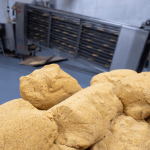
- Masa waits to be loaded into the cutting and oven machine to make tortillas.
-
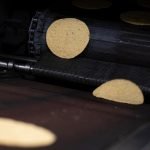
- Corn tortillas after being cooked at Mi Tierra Tortilla in Springfield.
-
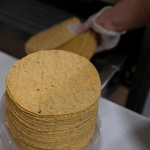
- Bagging corn tortillas after being cooked.
Longtime friends and business partners, Michael Docter and Jorge Sosa first met in Hadley, when Sosa was operating the Mi Tierra Restaurant in Hadley. Docter frequented the restaurant while he worked as a farmer for sixteen years on the Food Bank Farm, which he helped establish to supply fresh produce to The Food Bank of Western Massachusetts.
At the time, Sosa was experimenting with making his own tortillas and he was not satisfied with the available masa flours on the market. He says, “Corn tortillas are better when made from real, whole corn. Michael and I started talking about my idea. I asked a cousin in Mexico to send me some corn seed to try to grow here in Hadley.”
Docter continues, “I planted the seed and found the plant grew about 18 feet tall but never produced any corn. It stretched to the sky, looking for that Mexican sunshine, but it never found it in Hadley.”
It did not make sense to ship corn all the way from Mexico to make tortillas, so Docter and Sosa searched for a local corn variety. Sosa says, “Michael introduced me to one of his farmer friends to grow the corn for my tortillas that I used in my restaurant.”
On October 27, 2013, fire destroyed Sosa’s restaurant, along with 12 other businesses. Sosa continues, “When the restaurant burned down, Michael and the community helped get us back on our feet and we’ve been business partners ever since.”
At the time of the fire, Docter was farming at Winter Moon Roots farm and selling produce at five farmers’ markets. Docter notes, “When the fire happened, Jorge was committed to buy corn from five farms. He wanted to honor his commitments to the farmers growing corn especially for him, so he made the tortillas by hand and we sold them at farmers’ markets. People loved the tortillas and it became obvious that there was a demand for it.”
As Sosa rebuilt the restaurant, his business included a new line of retail corn tortillas. Docter says, “We became partners and figured it out.” Sosa, who owns 50% of Mi Tierra Tortillas, is from Queretero, Mexico and he brings his unique knowledge of the corn nixtamalization process to the effort. Sosa traveled extensively to see tortillarias in Mexico and California and was the primary force in designing the company’s production facility in Springfield.
Today, Mi Tierra partners with three local farms to grow corn varieties that are especially for tortillas. Once the local corn is exhausted, they also purchase from a farm in Hudson, New York. Docter estimates they typically use 400,000 pounds of corn per year, or approximately fifty acres of corn.
Tortillas are all about the corn. Docter explains, “For the last few thousand years, corn tortillas were one of the primary foods eaten by indigenous peoples in North and South America. For example, the Wampanoag diet consisted of 70% corn and beans. Because corn is more resistant to excess moisture, we hope to make corn tortillas the ‘bread’ of New England once again as extreme weather events become more frequent with climate change. By helping change the way people eat, we make the food system stronger and more resilient with a grain that can be reliably produced locally.”
Sosa says, “Michael taught me how to source the corn locally and how that supports the community, all the way from buying corn to donating to food pantries and survival centers, both here in the valley and in Springfield. Honestly, I just began wanting to make tortillas, but we have done something better.”
Sosa and Docter are committed to their recipe and the taste of fresh, natural tortillas. By eschewing preservatives, the process places a natural limit on how far they can ship tortillas. Distribution stays within our immediate region.
Mi Tierra Tortillas has a long-standing relationship with several survival centers and food pantries including Northampton Survival Center, Amherst Survival Center, Grow Food Northampton and others. Donating is built into their business model. Docter explains “We take back unsold tortillas at end of week and credit the grocery store—this generates a lot of tortillas that are still good, then we donate them.”
Along the way, Mi Tierra hired Jim Levey to manage its food distribution network. Levy spent most of his career working for food assistance agencies including the Northampton and Amherst Survival Centers. Levy ensures that the company serves those in need and that surplus production is quickly and efficiently routed to emergency food providers. Docter says, “Jim knows the folks at every food pantry in our entire region and incorporates these stops into his delivery route.” Last year alone, Mi Tierra donated over 17,000 pounds of tortillas.
Mi Tierra sells to public schools to help ensure that students have access to healthy, local food. Docter says, “Springfield Public Schools have a large percentage of students from Central America. By selling to Homegrown Springfield, we are getting students healthy, culturally-appropriate food.” He continues, “It’s important to us for everyone to have access to local food, not just for people who can afford to buy it. When we sell to public schools, we deliver organic tortillas at conventional prices.”
Strong community grows alongside heritage corn varieties and the trusted Mi Tierra recipe. For Docter, “What sustains my joy is being part of an amazing team of people. Jorge and the people that work with us in Springfield are absolutely solid as a rock. They understand the intricacies of how to nixtamalize corn and make corn into an incredible tortilla and they just keep doing it and whatever needs to happen, they make it happen.”
Sosa concludes, “We’re blessed to be here in Western Mass, where people are welcoming and open-minded. Our tortillas bring back memories for me of sitting in the kitchen and waiting for my mom to make them. I’m happy to be here and I’m happy that people appreciate our work and culture by enjoying our product.”
Find Mi Tierra Tortillas on Cinco de Mayo and every day at mitierratortillas.com, or purchase at River Valley Co-op, Long River Produce, Whole Foods, Quabbin Harvest Co-op, Franklin Community Co-op, Atkins Farm Market, State Street Fruit Store, Coopers Corner and the Old Creamery Co-op.
Lisa Goodrich is a Communications Coordinator with Community Involved in Sustaining Agriculture (CISA). To find more restaurants and specialty food products sourced from local farms, see CISA’s online guide at www.buylocalfood.org/find-it-locally.
Photos courtesy of Carol Lollis and the Daily Hampshire Gazette. Greenfield taco photo courtesy of Greenfield School Food. Taco picture CISA file photo.