VB: Prospect Meadow Farm

There is so much to learn by working on a farm. There are things to learn about growing plants and caring for animals, of course, but more too — things like how to work together on a team, how to show respect for yourself and others, and how to have fun, even in tough moments. As such, many programs throughout western Massachusetts use farming as a platform to help people become their best selves. Prospect Meadow Farm is one great example.
“Prospect Meadow Farm is a vocational training program of ServiceNet that gives adults with developmental disabilities and mental health challenges opportunities for hands-on skill-building,” explains Allie LaClair, the Senior Director of Operations for ServiceNet. “We have two farm sites in Hatfield, and we recently opened another site in Pittsfield.”
ServiceNet is a non-profit human services agency offering broad support to people with developmental disabilities and mental health challenges. Their programming goes way beyond vocational services to include counseling, sobriety support, day programs, and residential housing options. Prospect Meadow Farm, founded in 2010 by ServiceNet’s now Vice President of Vocational Services, Shawn Robinson, is the core of their vocational programming (Robinson also serves on the board of Community Involved in Sustaining Agriculture, CISA). Today, the farm is mostly overseen by LaClair and Maribeth Ritchie, ServiceNet’s Director of Operations for Supportive Employment.
Prospect Meadow “farmhands,” as they are called, are eligible to participate based on a referral from the Department of Disability Services or a school system. Currently, the Hatfield locations host about ninety farmhands and the new Pittsfield location hosts another thirty-five. Farmhands come from all four counties in western Massachusetts, and ServiceNet offers transportation between home and the jobsite, reducing barriers to participation.
“Really what this programming gives people is a lot more independence,” says LaClair. “It’s often a first job for many people, and we try to make it a really smooth transition, perhaps out of a school setting and into a work setting, that allows them to engage in real, meaningful work but with plenty of support. People gain experience and confidence, they can progress in their responsibilities, and they’re earning an actual wage too.”
Even though their main focus is human development, Prospect Meadow Farm still produces a lot of food. For example, “we have the largest log-grown shiitake mushroom operation in western Massachusetts, and I think one of the largest in New England,” says LaClair.
They also have a large flock of egg-laying hens, often raise pigs for meat, and harvest a sizable amount of seasonal produce from their fields. “In Pittsfield, we also have three greenhouses growing greens and produce through the winter,” adds Ritchie.
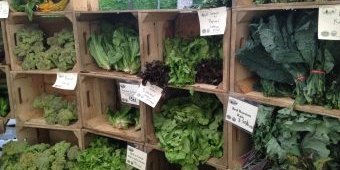
Much of that harvest is sold in three places: ServiceNet’s Rooster Café in Northampton, Prospect Meadow’s community supported Agriculture (CSA) program, and their year-round farm stores in Hatfield and Pittsfield. Each of these outlets allows them to share their bounty with the wider community and extend vocational training into new areas.
On the front end, the Rooster Café, located at ServiceNet’s main administrative building at 21 Olander Drive in Northampton, is open to the public Tuesdays through Fridays from 9am to 2pm, serving drinks, sandwiches, and salads. They also offer event catering. On the back end, it is the home of ServiceNet’s culinary training program. This is one of two specialized, skill-based training programs they offer— the other is their carpentry program.
“This is an eighteen-month program, after which we hope participants will graduate and find jobs in the food service industry,” explains Ritchie. “Usually, participants start working on the farm. Once they have some basic skills and an understanding of what they like, they might decide to move to the culinary or carpentry programs.”
Last year Prospect Meadow Farm’s CSA program had over 180 subscribers. Many are members of the general public, but they also provide highly subsidized CSA shares to seniors through the Senior FarmShare program run by CISA and to people living in human service agency residential programs, including those run by ServiceNet. For the latter group, Prospect Meadow Farm actually delivers CSA shares to their doorstep.
“A lot of people living in human service agency residential programs are interested in getting a CSA and having more fresh produce,” says LaClair, “but getting reliable transportation to pick it up every week is really hard. Offering delivery makes that so much more accessible.”
For the general public, they offer multiple sizes of CSA shares all promising a weekly box of fresh produce between mid-June and mid-October, as well as access to a pick-your-own garden. Some also include fresh eggs and farm-raised pork. Shares can be picked up at one of several locations and times throughout the Valley. More information and sign-up forms are available at their website: prospectmeadowfarm.org.
“One thing that we love about our CSA is it encourages the public to come see the farm itself and everything we’re doing here,” says LaClair. “It also creates so many kinds of jobs for our farmhands. They can be involved in the whole process from planting and growing to packaging things up and interacting with customers, at CSA pickups and at the farm store too.”
Zooming out a bit, Ritchie explains that Prospect Meadow Farm is just one of a growing movement of what are called care farms. “Some work with people with developmental disabilities,” she says, “but others work with veterans, people overcoming substance abuse, or just kids.”
What connects them is the not-so-radical idea that teaching hands-on skills in a supportive environment is a great way to grow healthy, happy humans, no matter their circumstances.
It may be true with any purchase from a local farm, but it is especially clear with Prospect Meadow Farm: “buying from us means you’re supporting a program that allows people to live their fullest lives,” says LaClair. “That’s what we’re all about.”
Jacob Nelson is a writer and educator with deep connections to local food and farms in western Massachusetts. This article was written in partnership with (CISA Community Involved in Sustaining Agriculture). To learn more about CSAs and local farms near you, visit buylocalfood.org.
This article ran in the Daily Hampshire Gazette on 2/14/26. Photos by Carol Lollis, courtesy of the Gazette.